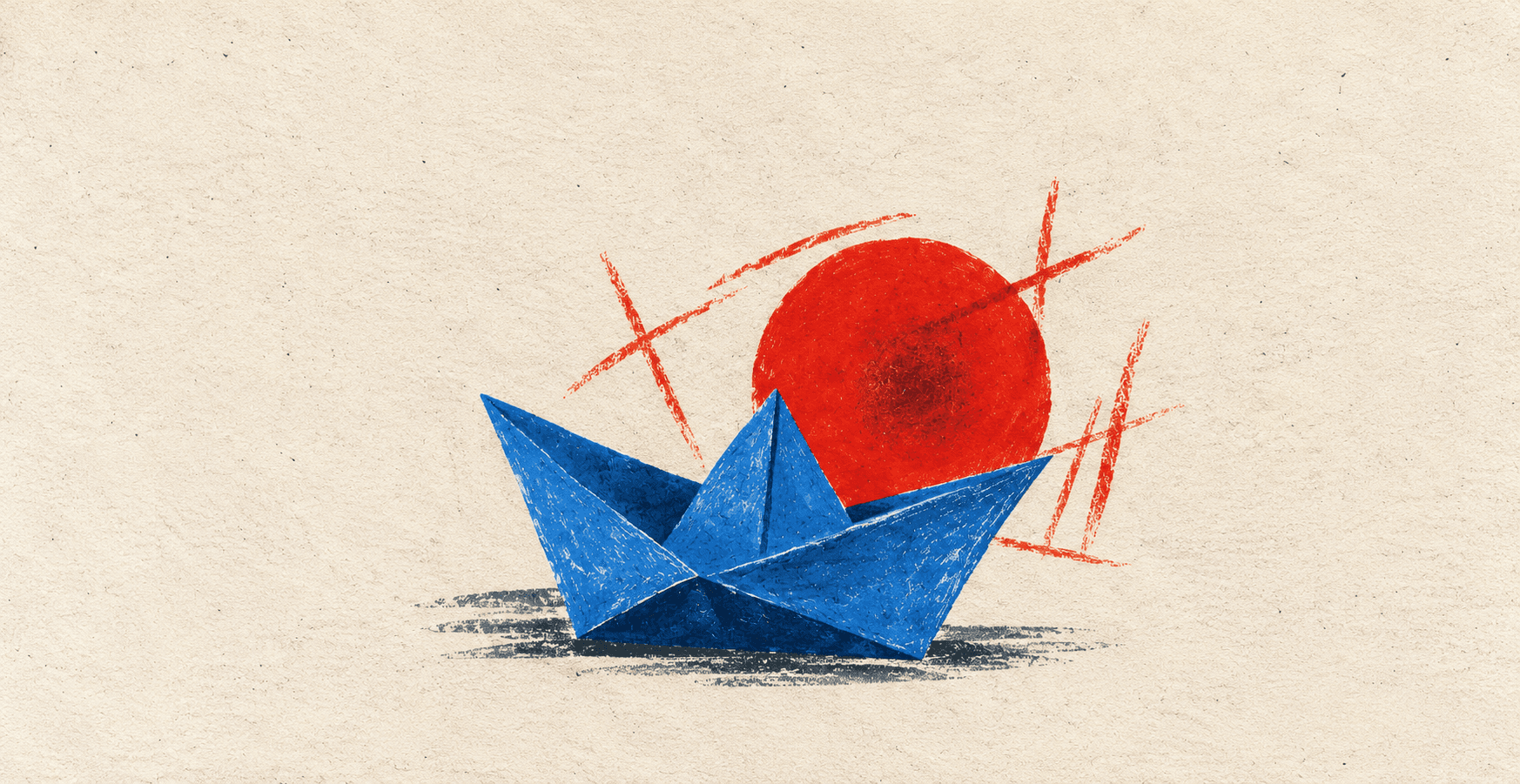
An Aesthetic of Almosts
There’s the work that gets made. And then there’s the work that lives only in your head, glowing faintly, like the afterimage when you close your eyes. As a designer, you learn to carry both: the reality that pays the bills and the dream that keeps you restless. This piece is about learning to live with those ghosts. It isn’t a complaint. It isn’t even nostalgia. It’s just the truth of making things in a world that asks for utility, while your heart asks for beauty.

I’ve been in design for over a decade now. Sounds like a long time, but in creative years it’s like being a stray cat who’s been dodging traffic for most of his lives. You collect dents, scratches, and the occasional look from a passing stranger who thinks, Why hasn’t this guy just found a safe job? And I have. Sort of. The problem is, it’s never felt safe.
I started as a graphic designer- the kind who thought choosing the right font was a spiritual experience. Helvetica wasn’t just a typeface; it was a way of life. Kerning felt like meditation. Alignment, a moral compass. Then the industry got faster, clients got more restless, and I evolved or mutated, into something else. In between, I picked up whatever new tool or language was fashionable, because standing still was the same as falling behind.
Somewhere in all that, I discovered a truth they don’t put in design school brochures: in this business, you’re always standing in the in-between. On one side is originality- the grand, romantic notion of creating something the world has never seen before. On the other side is… well, Can you make it look like that thing we saw on Pinterest?
The Commissioned Copy
Clients rarely mean to hurt you when they say that. It’s not personal. It’s just that originality feels risky to them. Familiarity is cheaper, safer, and comes with reference images. We love your style, they say, before emailing you a creatives which look suspiciously like another company’s campaign. And so begins the dance. You know that if you push too far into originality, you’ll get an email with the subject line: FEEDBACK: URGENT. If you copy too much, you’ll hate yourself and tell your friends, This wasn’t really my project.
The truth? Most designers live in this purgatory. We’re trying to smuggle originality into something that still passes the client’s comfort test. We’re like chefs who’ve been asked to make pasta just like Olive Garden, but somehow more… artisanal.

The Designer’s Double Life
On some days, I think of myself as two people. There’s Designer Me. Rational, disciplined, solving problems. Designer Me knows the user journey, checks accessibility standards, and thinks about scalability. Designer Me is a professional.
Then there’s Artist Me. Moody, unpredictable, prone to sudden obsessions with colours that no client will understand. Artist Me will spend three hours getting the perfect curve on a vector path, even though the client’s logo will be printed at the size of a postage stamp. Artist Me doesn’t care about user journeys. Artist Me wants the damn thing to sing.
Balancing the two feels like trying to walk a dog and a cat on the same leash. The dog’s all about purpose and forward motion, the cat just wants to wander off and stare at a shadow.

A Story about Chairs
Once, years ago, I was designing an app for a start-up that wanted to revolutionise the furniture-buying experience. They had this idea for a digital showroom where you could see every chair in 3D, rotate it, change the upholstery, all that jazz. I pitched a bold interface: soft gradients, playful typography, and a warm palette. It looked like Wes Anderson made a furniture app.
They loved it. Until someone on their team sent a screenshot of IKEA’s website and said, Can we make it more like this?
Now, IKEA is the design equivalent of The Beatles. Everyone likes it, it’s safe, and it works. But try telling Artist Me that the warm apricot I’d chosen should be swapped for IKEA Blue, and you’ll see what heartbreak looks like in RGB.
In the end, Designer Me won. The app shipped looking suspiciously Swedish. It worked too. But every time I see it, I think of the version that never existed, the one where the chairs sat in sunlight, not under fluorescent lighting.
The Private Work
The antidote is private work, the stuff you do at night, when no one’s watching. The poster for a band that doesn’t exist. The interface for an imaginary app. The sculpture made crumpled paper balls.
I’ve always had side projects. They remind me that I’m more than the sum of my client feedback emails. But here’s the twist: sometimes, a client sees my private work and says, Oooh! We're loving this. Can you do something like it for us? And I know, deep down, that something like it means water it down until it’s safe. That’s the cruel joke of the creative industry: the thing they fall in love with is the thing they’ll slowly dismantle.